
Every January, social media managers brace themselves for the avalanche of social media trend predictions. “Video is king!” “Use this audio to go viral on TikTok!” “AI will change everything!” But the real shifts happening in 2026 are less about which platform is hot. They’re about fundamental changes in how audiences consume content, what they’re willing to tolerate, and how we do our jobs.
For nonprofits and mission-driven organizations, the most important social media trends aren’t always the flashiest ones. Here’s what’s actually important to know in 2026 and what it means for your strategy.
AI Fatigue is Real (But So is the Confusion)
Here’s the thing about AI content in 2026: while audiences are getting smarter about spotting it, they are still getting duped by increasingly sophisticated fakes. It’s exhausting for everyone involved. Take for example, the loose monkeys in St. Louis, which has sparked an influx of AI-generated images of the monkeys around the city, resulting in a reporter asking a St. Louis City Department of Health official, “Are we 100% sure the monkeys are real?” Bet you never thought that would have to be asked at a press conference.
On one hand, people are calling out AI-generated content left and right – sometimes correctly, sometimes not. I’ve seen people accuse posts of being AI-written simply because they used an Oxford comma. As an Oxford comma lover, I will not give in. On the other hand, AI-generated images and videos are getting scarily good, and people are absolutely falling for deepfakes and manipulated content that looks incredibly real.
The result? Fatigue and confusion. Audiences don’t trust what they’re seeing, and they’re over trying to figure out what’s real and what’s generated. This creates both a challenge and an opportunity for mission-driven organizations.
What this means for you: Don’t abandon AI tools entirely; they’re incredibly useful for brainstorming ideas, organizing thoughts, or speeding up administrative tasks. But here’s the critical part: don’t just copy and paste anything AI gives you. Also, steer away from relying on it to create images and videos for your organization, since visuals entirely generated by AI are seeing strong backlash. It’s been said many times before, but it deserves repeating: AI should enhance your creativity, not replace it.
The Death of the Monthly Content Calendar
The uncomfortable truth is planning content 30 days in advance is becoming nearly impossible. Political and economic shifts happen overnight, especially with the unpredictable current administration. Cultural moments emerge without warning. A crisis can completely change your messaging priorities in an instant.
Consider this: you spend hours crafting a perfect month of content only to scrap half of it or have to move it all around because the world shifted. The rigid monthly content calendar assumes predictability that simply doesn’t exist anymore.
Enter “freedom within a framework.” Successful teams are moving toward rough monthly themes, biweekly or weekly tactical planning, with built-in flexibility for reactive content. This isn’t lack of planning; it’s strategic adaptability. When I adjust our content plan because of breaking news or a cultural moment, that’s not dropping the ball—that’s doing the job well.
TikTok’s American Algorithm: The Great Unknown
With TikTok finalizing a deal on January 22, 2026 with an Oracle-led group of US investors to restructure its American operations, the app is about to enter uncharted territory. This wasn’t a full sale since ByteDance still retains partial ownership, but the US version of TikTok will now operate under a new joint venture with American oversight.
Here’s where it gets complicated: Oracle is run by Larry Ellison, a prominent Trump ally, which raises questions about potential political pressure on content moderation. Add to that the fact that the US algorithm will be retrained using only American user data, and we’re looking at a fundamentally different platform than what we’ve been working with.
What does this mean for the algorithm we’ve all learned to navigate (and love)? How will content moderation shift? Will certain topics or creators be deprioritized? Nobody knows yet, and that uncertainty is worth paying attention to.
For now, don’t panic, but don’t assume TikTok 2026 will look like TikTok 2025. If your organization has been successful on the platform, keep doing what works while staying observant. Watch your analytics more closely than usual. The changes could be subtle or significant – we won’t know until we’re in it.
The bigger lesson: Platform instability is the new normal. Whether it’s Twitter becoming X, Instagram constantly tweaking its algorithm, or TikTok’s ownership drama, the platforms we rely on are increasingly unpredictable. Diversification and adaptability aren’t optional anymore; they are the most important social media trends to act on this year.
Creator Partnerships Are Growing Up
The era of hiring 10+ influencers for one-off posts is fading. Instead, smart organizations are building longer-term partnerships with fewer creators and seeing better results. An Influencer Marketing report by Famesters found that 63.2% brands now preferring sustained collaborations over one-time engagements.
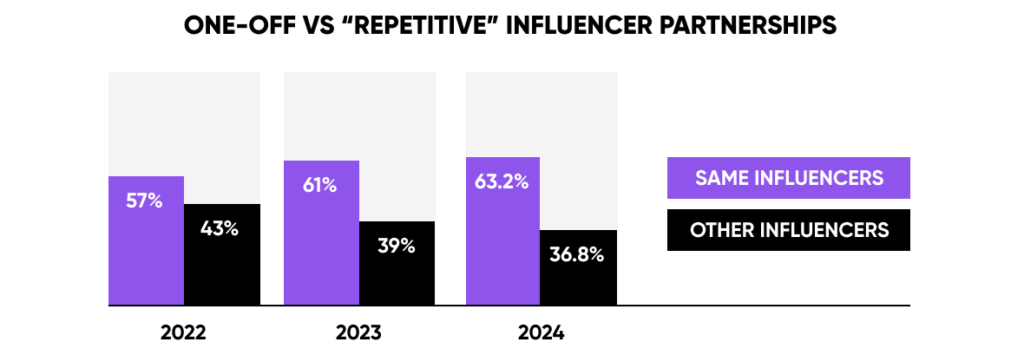
Source: Famesters
Additionally, smaller, niche creators continue to drive more authentic engagement than mega-influencers. A nonprofit partnering with a micro-influencer who genuinely cares about their mission will see more meaningful (and lasting) impact than a large influencer posting once and moving on.
What this looks like: Instead of 10 influencers for one campaign, invest in 2-3 creators for ongoing collaboration. Build actual relationships, not just transactional partnerships. For nonprofits, you don’t need one viral moment, you need sustained mission advocacy from people who actually believe in your work. Their followers will likely care as well and be more engaged in the content around your organization because the creator will be more involved too.
Authenticity as a Requirement
All of these social media trends point to one central truth: authenticity (yes, it’s a trendy marketing buzzword, but it’s a buzzword for a reason) is a requirement for survival. Audiences can spot AI-generated content, corporate messaging, and content calendar box-checking from a mile away. They’re choosing to engage only with content that feels real, human, and honest, the “pick up your phone and start filming” kind of honest.
This means less polish and more personality. Behind-the-scenes moments. Mistakes acknowledged. Real humans behind the account, not perfectly branded content. I’ve seen posts with typos or off-the-cuff videos outperform meticulously crafted campaigns because they felt genuine. I’m not saying start purposefully misspelling words, but a typo isn’t the end of the world. It reminds people there’s a real human running the account.
The challenge for nonprofits: Leadership may resist “less polished” content because they err on the side of professionalism. But that’s not where engagement lives anymore. Your executive director speaking candidly to camera about a challenge? That will resonate. Your perfectly lighted and scripted promotional video might get scrolled past. Don’t let perfection be the enemy of progress.
The Bottom Line
Unlike the typical social media trends you’ll see in every other roundup—the through-line here is flexibility, authenticity, and human connection. The organizations that will thrive on social media in 2026 won’t be those with the biggest budgets or the most polished content, they will be those that are willing to be real, adapt quickly, take some content risks, and build genuine relationships with their communities.
So yes, keep an eye on emerging platforms and new features. But more importantly, focus on the fundamentals: real stories, real people, and the agility to meet your audience where they are, even when “where they are” changes faster than you can plan for. And a reminder to give yourself grace – building and growing your social media presence is a marathon, not a sprint.
