

With thousands of nonprofits in the marketplace, good branding is essential for an organization’s important work to be noticed and supported. On a recent Talking Nonprofits with Teak Media podcast, Teak Media Founder and President Jackie Russell asked one of the best in the business, Proverb Founder and Managing Director Daren Bascome, the secrets behind helping nonprofits find their voice.
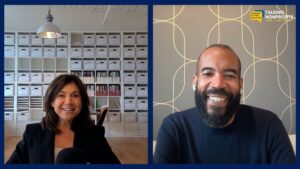
Q: What does your company Proverb focus on?
A: Proverb focuses on the things that make cities great. We work with various anchor institutions like healthcare, social safety nets, philanthropic, cultural organizations, and municipalities to drive new narratives for tourism or economic development. We also have a robust commercial real estate practice that ranges from different kinds of housing to office and lab space.
Q: How did you get into this unique work?
A: I got into it step by step. My background was in exhibit design, which involved distilling information into two or three key things to wrap a story around then use various disciplines including architects, writers, filmmakers and lighting designers to tell that story. That experience set the tone for Proverb’s branding work.
Q: What is a common theme in Proverb’s work?
A: A recurring theme in Proverb’s work is the intersection between research and strategy, design and storytelling, a purpose-driven place or community, and a real sense of vibrancy or belonging.
Q: Can you give examples of some of Proverb’s recent work?
A: In recent years, Proverb has worked with the City of Boston on its tourism brand and campaign, rebranded the Island of Bermuda, and the Massachusetts Office of Travel and Tourism on the semi-quincentennial, and many others.
Q: What problems do nonprofits often face with branding and campaigns?
A: Nonprofits can be a different breed all their own. They often have large, complicated missions and tend to think about how to talk to each of the audiences they need to address such as donors, volunteers, civic leaders, potential employees, and the general public. However, a powerful brand is almost always connected to a purpose-driven organization. The challenge is to communicate that mission and the work to all of stakeholders in a way that’s meaningful to them.
Q: How does Proverb help nonprofits understand who they are talking to and what their message needs to be for different audiences?
A: To create a unifying brand idea, Proverb first seeks to understand the audience or audiences and find intersections between what motivates them and any existing perceptions they have about the organization that might hinder its success. We use a combination of primary and secondary research, looking at cultural and geographical influences, as well as the competitive landscape to inform our branding work.
Q: What is an example of Proverb’s work with a nonprofit?
A: We worked with a popular tourist destination known for entertainment and education that had been quietly doing a lot of scientific research and environmental advocacy and wanted to move that work into the center of the brand. We used field research to understand whether audiences care about this work and tested whether talking about it in a way that felt important to them would positively impact their willingness to engage. We found that when audiences understood the organization’s research and advocacy, especially when connected to the planet’s mission, their likelihood to engage went up exponentially.
Q: What results did Proverb achieve for this nonprofit?
A: The results included increased volunteerism, more donations, and a greater understanding of the organization overall, including increased visitation. It created an additional sense of mission where for the price of admission you are also supporting saving the planet.
Q: How does Proverb measure the impact of their campaigns?
A: We track engagement with ads, website stay time, and which areas of the site users spend the most time in. We also commission brand lift studies to see how perception shifts before and after exposure to messages. In one campaign, we saw an 8.7 point lift. A typical lift for a nonprofit is 1.7 points. It was way above and beyond in terms of impact.
Q: You’ve said in the past that nonprofits don’t understand that people don’t know who they are or what they do. Explain why your work is so important.
A: The average person is exposed to thousands of ads daily. Nonprofits are competing for mind share, funding, employees and attention. It’s not just about the need that they are addressing, but how they talk about that need and how addressing it might serve a broader constituency or the general public. We help our clients leverage the impact of what they’re doing in the largest ways we can.
You can find a link to the full video version of this interview here.
