

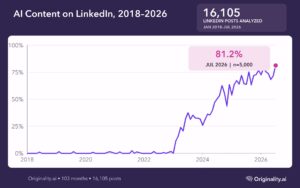
Anyone who has seen images of President Trump depicted on his social media channels this week as everything from a decorated war hero to Elvis, knows what “AI slop” is. The president is hardly alone in his seeming addiction to the stuff. AI-generated material is now impossible to avoid, from world leaders to viral celebrity gossip to small business pages. A recent Originality.AI study found more than 81% of long-form LinkedIn posts now read as likely AI-generated. They come in the form of uncanny videos, LinkedIn posts that read the same no matter who supposedly wrote them, and fabricated “news” moments that spread before anyone can catch them. Euronews reported that during this year’s World Cup, an AI video showing Lionel Messi faking an injury hit 8 million views on X before viewers noticed the Swiss players were wearing the wrong uniforms.
Platforms Are Fighting Back
Some of the social media platforms that used to let this content run wild are finally pushing back. The gap between AI adoption and AI trust is why platforms are stepping in. LinkedIn is testing a “Seems like AI slop” reporting option that lets members flag content that appears to be AI-generated, feeding those reports into detection models that reduce flagged content’s reach, and retired its “enhance your post” AI writing feature for a proofreading tool that preserves a person’s voice.
Snapchat is demoting fully AI-generated videos in its Spotlight feed while still supporting human-made content and AI-assisted edits, with CEO Evan Spiegel direct about the goal: stopping AI slop from taking over the feed. And Substack’s new detection feature, built with Pangram, enables readers to check whether writing was likely AI-generated, and lets writers disclose their own AI use.
What Is AI Slop?
AI slop is the catch-all term for low-effort content churned out by generative AI with little human editing: buzzword-stuffed posts, fabricated “news” images, synthetic influencer videos, and fake accounts built around AI melodramas that rack up views and ad revenue on platforms like X, as Wired has documented. What separates slop from ordinary AI content is intent: produced fast and cheap to farm engagement, polished on the surface with nothing real underneath.
How to Spot It
AI slop still has recognizable patterns, though the classic visual tells are getting harder to rely on as technology advances. Watch for:
- Overly polished, generic language. Posts that hit every trend or buzz word but say nothing specific to the poster.
- Suspiciously tidy or melodramatic narratives. Stories engineered for maximum emotional payoff that can’t be traced to a real source.
- Visual tells. Warped hands/features or details that don’t match reality, like the incorrect uniforms that gave away the fake Messi video or too many fingers on hands. Giving a quick scan with a critical eye for any flaws or inconsistencies is a good first test.
- Repetition with no specifics. Check the account the content is coming from. If it’s a random account that is sharing an unusual number of near-identical style posts, with no names, dates, or details anyone could verify, it’s likely AI.
- AI-generated flyers. Machine-made flyers and event ads have become a common sighting on social media, and they carry a recognizable look: overly polished images, bright colors on black backgrounds, brushstroke fonts with glowing outlines, crowded compositions, and graphics or text filling every inch of the flyer, as The Charlotte Observer reported.
Detection tools help too, though The New York Times reports even the best are still far from perfect. Some platform leaders favor a different fix for images and video: verify what’s real using camera metadata and creator history, rather than chase what’s fake.
Why People Post It
Good content is expensive and time-consuming to make, and generative tools promise a shortcut. Some social media users chase quick engagement and ad revenue that used to require real production work, while others feel pressure to post constantly with limited time to create content. That sits inside a bigger reckoning with generative AI, too: artists’ objections to models trained on their work without credit, discomfort with AI creating hyper realistic people, worries about data centers’ environmental cost, and the jobs at stake in writing, design, and photography. Audiences are noticing and are not thrilled: 69% of Americans now distrust AI companies’ motives, even as AI adoption itself keeps climbing.
Why Authentic Posting Still Wins
The lesson is straightforward for organizations and brands. People can tell when content feels manufactured. Posting something generic and AI-polished might save time, but it risks the thing that actually drives engagement: trust. That matters most for nonprofits and mission-driven organizations: trust is the whole relationship. Supporters, donors, and volunteers show up because they believe in the people and work behind an organization, and that belief depends on real voices and real impact. A single clearly AI-generated photo can undo years of credibility.
AI-generated flyers have become such a recognizable red flag that they’ve spawned backlash to what 404 Media has dubbed the “ChatGPT flyer pandemic.” One person posted a parody version of an ad on Facebook, which said:”Hey if this is your flyer, I’m not going, I’m not donating, I’m not sharing,” The Charlotte Observer reported that the prevailing opinion online toward these ads is negative, with some people going as far as to boycott businesses that use AI-generated imagery.
AI itself is a genuine tool for helping small teams do more with limited staff and time. It can draft an outline, offer ideas when creators are creatively stuck, organize meeting notes, and speed up admin work so people can spend more time on programs and relationships. The goal should be to use AI as an efficiency that supports your mission, not a shortcut that replaces the people and stories at its center. Real photos and your own voice will always read as more credible than anything generated in bulk.
Before you hit publish, ask whether a real person could have created it, whether the images make logical sense, whether content sounds like your brand’s voice, and whether you would be surprised if a commenter called it out as AI generated. If you have to pause and think about it, don’t publish. Your credibility is on the line.
